Techknow_Study

Archive for the category “Computer World”

Network Printer

Connect Printer in Network with other Computer in windows XP

1.  Click on Start button , then click on Control panel, Then click on Printer and Fax and Click on Add printer then Next
      Or 
Click on Start button , Then Click on Run option , then Type Control printers , then click on Add printer then Next


2. Select A network printer or a Printer , or a printer attached to another computer option, then click on Next


3. Select Connect to this printeroption
 

SQL Injection

SQL Injection

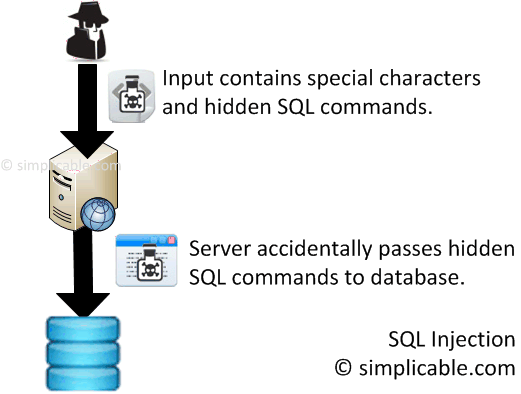
Many web developers are unaware of how SQL queries can be tampered with, and assume that an SQL query is a trusted command. It means that SQL queries are able to circumvent access controls, thereby bypassing standard authentication and authorization checks, and sometimes SQL queries even may allow access to host operating system level commands.

Direct SQL Command Injection is a technique where an attacker creates or alters existing SQL commands to expose hidden data, or to override valuable ones, or even to execute dangerous system level commands on the database host. This is accomplished by the application taking user input and combining it with static parameters to build an SQL query


SQL injection is an attack in which malicious code is inserted into strings that are later passed to an instance of SQL Server for parsing and execution. Any procedure that constructs SQL statements should be reviewed for injection vulnerabilities because SQL Server will execute all syntactically valid queries that it receives. Even parameterized data can be manipulated by a skilled and determined attacker.
The primary form of SQL injection consists of direct insertion of code into user-input variables that are concatenated with SQL commands and executed. A less direct attack injects malicious code into strings that are destined for storage in a table or as metadata. When the stored strings are subsequently concatenated into a dynamic SQL command, the malicious code is executed.
The injection process works by prematurely terminating a text string and appending a new command. Because the inserted command may have additional strings appended to it before it is executed, the malefactor terminates the injected string with a comment mark “–“. Subsequent text is ignored at execution time.
The following script shows a simple SQL injection. The script builds an SQL query by concatenating hard-coded strings together with a string entered by the user:


  • The following script shows a simple SQL injection. The script builds an SQL query by concatenating hard-coded strings together with a string entered by the user:
var Shipcity;
ShipCity = Request.form ("ShipCity");
var sql = "select * from OrdersTable where ShipCity = '" + ShipCity + "'";

The user is prompted to enter the name of a city. If she enters Redmond, the query assembled by the script looks similar to the following:

SELECT * FROM OrdersTable WHERE ShipCity = ‘Redmond’

Launch day

  • Launch  day


  • The day for which so many users waiting come in front of us. When new windows version that is window s 8 is launched in market.
  •  Around the world, people gather to experience and celebrate Windows 8 as it prepares to launch on 10.26.2012 that is today .
  • windows 8 have so many features which gives you better experience than the the older  version yes windows 8 also take the feature of windows older version with some additive quality.
  • it have increased GUI {graphical user interface}.

    preview of windows 8 preview

IP spoofing

The top five ways to prevent IP spoofing
Computerworld – The term “spoofing” is generally regarded as slang, but refers to the act of fooling — that is, presenting a false truth in a credible way. There are several different types of spoofing that occur, but most relevant to networking is the IP spoof. Most types of spoofing have a common theme: a nefarious user transmits packets with an IP address, indicating that the packets are originating from another trusted machine.
The first step in spoofing is determining the IP address of a host the intended target trusts. After that, the attacker can change the headers of packets to make it seem like the transmissions are originating from the trusted machine.


What sorts of attacks are launched through IP spoofing? To name a few:

  • Blind spoofing: In this type of attack, a cracker outside the perimeter of the local network transmits multiple packets to his intended target to receive a series of sequence numbers, which are generally used to assemble packets in the order in which they were intended — Packet 1 is to be read first, then Packet 2, 3 and so on.
The cracker is blind to how transmissions take place on this network, so he needs to coax the machine into responding to his own requests so he can analyze the sequence numbers.
By taking advantage of knowing the sequence number, the cracker can falsify his identity by injecting data into the stream of packets without having to have authenticated himself when the connection was first established. (Generally, current operating systems employ random sequence number generation, so it’s more difficult for crackers to predict the correct sequence number.)
  • Nonblind spoofing: In this type of attack, the cracker resides on the same subnet as his intended target, so by sniffing the wire for existing transmissions, he can understand an entire sequence/acknowledge cycle between his target and other hosts (hence the cracker isn’t “blind” to the sequence numbers).
Once the sequence is known, the attacker can hijack sessions that have already been built by disguising himself as another machine, bypassing any sort of authentication that was previously conducted on that connection.
  • Denial-of-service attack: To keep a large-scale attack on a machine or group of machines from being detected, spoofing is often used by the malefactors responsible for the event to disguise the source of the attacks and make it difficult to shut it off.
Spoofing takes on a whole new level of severity when multiple hosts are sending constant streams of packet to the DoS target. In that case, all the transmissions are generally spoofed, making it very difficult to track down the sources of the storm.
  • Man-in-the-middle attack: Imagine two hosts participating in normal transmissions between each other. In a man-in-the-middle attack, a malicious machine intercepts the packets sent between these machines, alters the packets and then sends them on to the intended destination, with the originating and receiving machines unaware their communications have been tampered with; this is where the spoofing element enters the equation.
Typically, this type of attack is used to get targets to reveal secure information and continue such transmissions for a period of time, all the while unaware that the machine in the middle of the transmission is eavesdropping the whole time.Spoofing, while mostly negative, has some more or less legitimate applications. Satellite Internet access is one. Packets going to orbit and coming back have a relatively long latency, and there are a lot of protocols in common use that don’t take well to this delay.
Satellite providers may spoof these protocols, including IP, so that each end of a packet flow receives acknowledgment packets without much delay.
Also, since VPN applications are particularly prone to problems with latency, special software from these providers generally performs more “accepted” spoofing.
But the bad kind of spoofing can be controlled. There are five things, among others, that you can do to help prevent IP spoofing and its related attacks from affecting your network:
  1. Use authentication based on key exchange between the machines on your network; something like IPsec will significantly cut down on the risk of spoofing.
  2. Use an access control list to deny private IP addresses on your downstream interface.
  3. Implement filtering of both inbound and outbound traffic.
  4. Configure your routers and switches if they support such configuration, to reject packets originating from outside your local network that claim to originate from within.
  5. Enable encryption sessions on your router so that trusted hosts that are outside your network can securely communicate with your local hosts.


Electronics Engineering

Some Topics in Electronics Engineering


Nanometer Wavelength Printing

  • Electronic circuits are “printed” by exposing silicon wafers to ultraviolet light and etching the circuit design into the silicon surface. The complexity of the chips is limited by how small the wavelengths of the light are; in a real world analogy, you cannot draw a finer line then the thickness of your pen tip. There is research into using different combinations of lenses and electromagnetic spectrum emissions to etch at even smaller nanometer resolutions. However, there may be a limit to this process if the wires are printed too close to each other; the magnetic fields of the electrons themselves could interact with each other and slow each other down.

Liquid Cooling

  • Liquid cooling is well understood when it comes to mechanical applications — your car engine, for example — but cooling circuits with liquids is still being researched. In 2011, only high-end computers use liquid cooling and even then there is a risk of leaks and damage to the circuits. Research is being conducted into nonconductive coolants and leakproof heat exchanges. Laptop applications are also being researched as laptop computers grow in power to rival desktops.

    Photonics

    • Photonics is the science of using light, primarily lasers, to transmit information and data. Fiber-optic Internet connections are a example of this technology already being used in the real world. In the field of electronics there is a push to use photonics to replace circuits, with lasers taking the place of electrons and circuits being made of fiber-optic wires and mirrors. The benefit of this design is that there is very little heat and programming needs little adaption, since a photonics circuit can operate in binary the same as an electrical circuits.

    Quantum Computing

    • The cutting edge of electronics engineering is quantum computing, which is incredibly complex but could allow for actual artificial intelligences. Quantum computing uses quantum particles instead of binary bits. The difference is that quantum particles can be used to run trinary programs. Quantum particles can have three polarities: up, down, and “maybe.” Until a quantum particle is observed, it can have either polarity depending on its entanglement with another quantum particle.

Windows 8 triple

Can you predict which 1 is best linux Os

My personal views are Ubuntu for desktop and Red Hat for servers.

1. Ubuntu
Like most of you, Ubuntu is my 1 choice for desktop Linux. Ubuntu is the 1 in the Linux desktop market and some use Ubuntu for the servers also. You will feel safety in Ubantu. It is more secure. Ubuntu offers the following three editions.
  • Ubuntu Desktop Edition
  • Ubuntu Server Edition
  • Ubuntu Notebook Remix
Added Details:

2. Fedora
                                        
Fedora is sponsored by Red Hat. If you are interested in experimenting with the the leading technologies, you should use fedora, as the release cycle is very short and fedora tends to include the latest technology software/packages in it’s distribution. It is hard to conclude which side of Fedora is more popular to the Internet audience
Added Details:
3. CentOS
                                     
If your organization does not want to spend money on purchasing Red Hat support, but still want all the benefits of the red-hat distribution, this is obviously the best choice, as this is totally based on the red-hat enterprise Linux.

As you can imagine the Nort American Enterprise Linux vendor mentioned in the quote below is Red Hat.

CentOS 2, 3, and 4 are built from publically available open source SRPMS provided by a prominent North American Enterprise Linux vendor. CentOS is designed for people who need an enterprise class OS.
Added Details:
4. Red Hat

                                
This is my favorite server distribution.  If an organization doesn’t mind spending dollars on purchasing the red-hat support, this is always my 1 recommendation to any organization who runs mission critical applications.

On a side note, one of the reason I like Red Hat Linux for mission critical production application is that Red Hat tends to take some of the new features from Fedora, which is well tested by the community.

Added Details:

Media Access Control Sub Layer

Media Access Control Sub Layer 

 
Round Robin Techniques
In Round Robin techniques, each and every node is given the chance to send or transmit by rotation. When a node gets its turn to send, it may either decline to send, if it has no data or may send if it has got data to send. After getting the opportunity to send, it must relinquish its turn after some maximum period of time. The right to send then passes to the next node based on a predetermined logical sequence. The right to send may be controlled in a centralized or distributed manner. Polling is an example of centralized control and token passing is an example of distributed control as discussed below.
Polling
The mechanism of polling is similar to the roll-call performed in a classroom. Just like the teacher, a controller sends a message to each node in turn. The message contains the address of the node being selected for granting access. Although all nodes receive the message, only the addressed node responds and then it sends data, if any. If there is no data, usually a “poll reject” message is sent back. In this way, each node is interrogated in a round-robin fashion, one after the other, for granting access to the medium. The first node is again polled when the controller finishes with the remaining codes.
The polling scheme has the flexibility of either giving equal access to all the nodes, or some nodes may be given higher priority than others. In other words, priority of access can be easily implemented.
                        Figure
Polling can be done using a central controller, which may use a frequency band to send outbound messages as shown in Fig. 5.2.2. Other stations share a different frequency to send inbound messages. The technique is called frequency-division duplex approach (FDD). Main drawbacks of the polling scheme are high overhead of the polling messages and high dependence on the reliability of the controller.
Polling can also be accomplished without a central controller. Here, all stations receive signals from other stations as shown in Fig. 5.2.3. Stations develop a polling order list, using some protocol. 

Token Passing 
In token passing scheme, all stations are logically connected in the form of a ring and control of the access to the medium is performed using a token. A token is a special bit pattern or a small packet, usually several bits in length, which circulate from node to node. Token passing can be used with both broadcast (token bus) and sequentially connected (token ring) type of networks with some variation in the details as considered in the next lesson.
In case of token ring, token is passed from a node to the physically adjacent node. On the other hand, in the token bus, token is passed with the help of the address of the nodes, which form a logical ring. In either case a node currently holding the token has the ‘right to transmit’. When it has got data to send, it removes the token and transmits the data and then forwards the token to the next logical or physical node in the ring. If a node currently holding the token has no data to send, it simply forwards the token to the next node. The token passing scheme is efficient compared to the polling technique, but it relies on the correct and reliable operation of all the nodes. There exists a number of potential problems, such as lost token, duplicate token, and insertion of a node, removal of a node, which must be tackled for correct and reliable operation of this scheme.
 
A token ring network
Token passing mechanism
Performance: Performance of a token ring network can be represented by two parameters; throughput, which is a measure of the successful traffic, and delay, which is a measure of time between when a packet is ready and when it is delivered. A station starts sending a packet at t = t0, completes transmission at t = t0 + a, receives the tail at t0 + 1 + a. So, the average time (delay) required to send a token to the next station = a/N. and throughput, S = 1/(1 + a/N) for a1.
Token passing mechanism
Contention-based Approaches
Round-Robin techniques work efficiently when majority of the stations have data to send most of the time. But, in situations where only a few nodes have data to send for brief periods of time, Round-Robin techniques are unsuitable. Contention techniques are suitable for burst nature of traffic. In contention techniques, there is no centralized control and when a node has data to send, it contends for gaining control of the medium. The principle advantage of contention techniques is their simplicity. They can be easily implemented in each node. The techniques work efficiently under light to moderate load, but performance rapidly falls under heavy load.

The Ada Programming Language


History

The Ada language is the result of the most extensive and most expensive language design effort ever undertaken. Up until 1974 half of the applications at The Department of Defense were embedded systems. An embedded system is one where the computer hardware is embedded in the device it controls. More than 450 programming languages were used to implement different DoD projects, and none of them were standardized. Because of this, software was rarely reused. For these reasons, the Army, Navy, and Air Force proposed to develop a high-level language for embedded systems.
By 1977, a complete language design specification for Ada was created. In April 1977, four proposing contractors were chosen to produce Phase I of the language design. In February 1977, Phase I of the language design was complete. Following this, was a two month evaluation period where 400 volunteers in 80 teams chose two out of the four as being the best language designs. These two companies were then given the go ahead to produce Phase II of the project. At the end of Phase II, another two month evaluation period took place. In May of 1979 the Cii Honeywell/Bull (the only foreign contractor) language design was chosen as the winner. Phase III of the project began after the winner was selected. After a winner was selected, the language design was published by the ACM. In November 1979, over 500 language reports were received from 15 different countries. Most of the reports suggested minor changes in the design, none real drastic. Based on these suggestions, a revised language design was published in February of 1980. After some minor changes to this document over the next few years, the final official version of the language was settled upon. The Ada language was then frozen for the next five years.


Significant Language Features

  • Packages – Data types, data objects, and procedure specifications can be encapsulated into a package. This supports the program design of data abstraction.
  • Exception Handling – Ada has very good exception handling capabilities which allow the program to handle its own run-time errors.
  • Generic Program Units – It is possible to write a procedure (for example, a sorting procedure) which does not require a data type to be specified.
  • Parallel / Concurrent Processing – Ada supports parallel and concurrent execution of tasks.
  • Ada 95 Will Add
    • Support for object-oriented programming
    • More flexible libraries
    • Better control mechanisms for shared data

Areas of Application

  • Government (Department of Defense)
  • Banking systems
  • Commercial aviation
  • Communications systems
  • Computer-Aided Design
  • Manufacturing

Linux vs. Windows web Hosting?

Linux vs. Windows web Hosting, does it make a difference?

One of the most confusing decisions someone new to web hosting will have to make is which platform their server should be on. There are a number of different choices out there but the main two are Linux and Windows web servers. There are also a lot of sources of information about hosting, but the majority of them are tainted by the author’s biased personal opinion unfortunately confusing the issue. Having just put in some solid hours researching the topic I have come to the conclusion that in general it quite probably does not matter which server you use. For the majority of people it will be far more important to choose a really good web host than to worry about the server-type that they implement.
web hosting


In terms of performance there’s not a huge difference between the two servers. Linux reportedly performs faster because Windows (as usual) attempts to offer an ‘all in one’ package instead of the extendable Linux implementation. You’ll generally not notice a difference but if performance is of utmost importance to you then maybe this will influence your decision.

The reliability and stability of the different platforms have been the topic of many long arguments. The main reason that Windows is seen as being insecure is that it is the most widely used operating system for home PC’s. People spend more time looking for flaws in the most common system. With Linux being the most common server type, it has a surprising number of successful hack attempts made on it. In the end the security of both platforms comes down to the competency of the system administrators. If you are security minded then you’ll do better to make sure that the hosting company is reputable and highly skilled than to worry about the server they use.


Read more…

Post Navigation

Design a site like this with WordPress.com
Get started